Did Cannabis Come From the Stars?
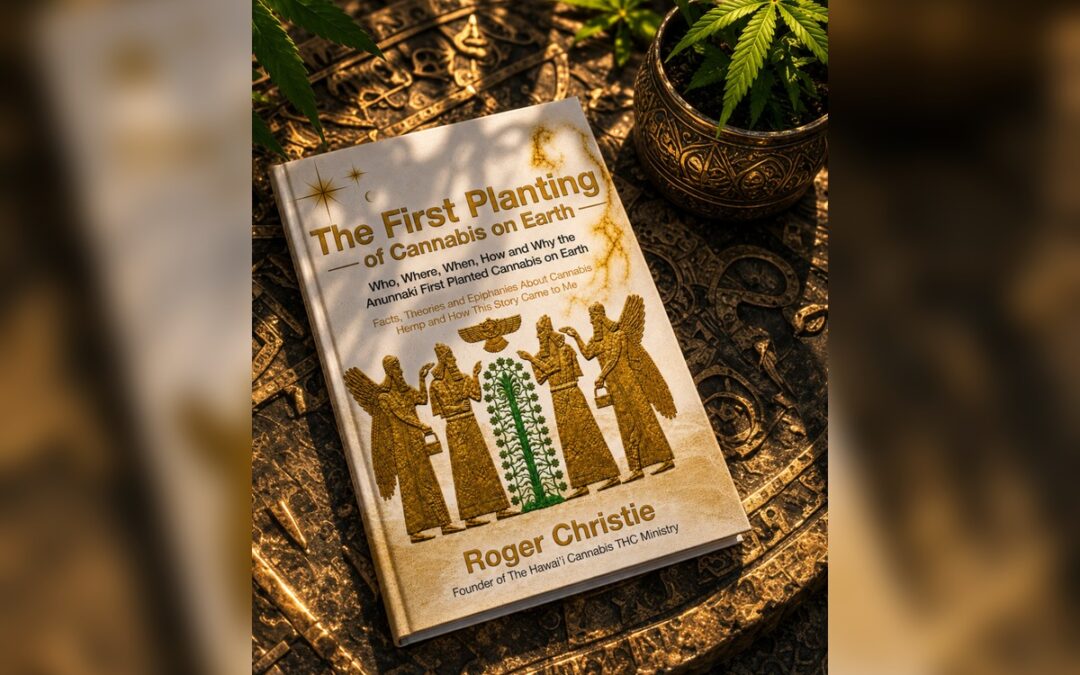
In The First Planting of Cannabis on Earth, longtime activist Roger Christie turns a lifetime of persecution, spiritual exploration and cannabis advocacy into one extraordinary
question.
Cannabis is almost suspiciously useful.
Its fibers can become clothing, rope, paper and building material. Its seeds provide food and oil.
Its compounds can ease pain, stimulate appetite, quiet nausea, reduce seizures and alter
consciousness. For thousands of years, humans have used it as medicine, material and sacrament.
Then there is the endocannabinoid system, an entire biological network that helps regulate
balance throughout the human body. We produce our own endocannabinoids and contain
receptors that interact with compounds found in cannabis with remarkable precision.
None of that proves cannabis came from another world. Still, it is enough to make a curious
person wonder whether there might be more to this plant’s story than we currently understand.
Roger Christie has spent much of his life wondering.
In The First Planting of Cannabis on Earth, Christie presents his theory that cannabis may have
been brought here by the Anunnaki, the divine beings described in ancient Mesopotamian
traditions. He believes the Anunnaki healer Ninmah carried cannabis seeds to Earth roughly
450,000 years ago and planted them near Baalbek in present-day Lebanon.
According to Christie’s interpretation, the plant was used to create an elixir that helped these
celestial visitors restore their health, improve their moods and adjust to the faster rhythm of life
on Earth. Humanity eventually inherited both the plant and a biological system designed to
benefit from it.
It is a wild theory, but this is not a book to read with your mind already made up.
Christie identifies the book as a collection of “facts, theories and epiphanies,” which is the right
way to approach it. He is sharing the culmination of decades spent studying cannabis, religion,
ancient mythology, human biology and the institutions that have tried to control our relationship
with all of them.
Most importantly, he is sharing the life that led him there.
A Life Built Around the Plant
The strongest part of the book is Christie’s own history.
Long before legalization became a politically safe position, he was openly challenging cannabis
prohibition. After arriving on Hawai‘i Island in 1986, Christie joined the Marijuana Political
Action Committee, challenged the state’s eradication program, helped establish the Hawaiian
Hemp Company and eventually founded the Hawai‘i Cannabis THC Ministry.
The ministry treated cannabis as a legitimate sacrament. It provided fellowship, counseling,
weddings, funerals, hospital visits and cannabis products to its members. Christie also helped
lead the successful 2008 Peaceful Sky initiative, which made the personal adult use of cannabis
the lowest law-enforcement priority in Hawai‘i County.
This was not social-media activism. Christie attached his name, face, livelihood and freedom to
the cause.
Federal authorities viewed the ministry as an illegal cannabis distribution operation. Christie
viewed it as the sincere exercise of religious freedom. In July 2010, he and 13 others were
arrested. Christie ultimately pleaded guilty to cannabis distribution and tax charges. He received
a five-year sentence in 2014 and describes spending 50 months in federal detention.
Whatever someone thinks of Christie’s theology or legal strategy, his commitment cannot be
dismissed. He placed his liberty behind his belief that cannabis is sacred.
That experience gives the rest of the book its emotional weight.
Christie writes that he survived detention by blessing his circumstances instead of cursing them.
Through prayer, reflection and the Hawaiian practice of ho‘oponopono, he searched for whatever
good could be found inside an experience meant to break him.
It was there, separated from cannabis and confined inside the Federal Detention Center in
Honolulu, that the pieces of his theory began falling into place.
Following the Plant Through History
From Christie’s life story, the book expands into ancient Mesopotamia, biblical scripture, human
evolution and alternative history.
Drawing heavily from Zecharia Sitchin and other writers, Christie connects the Anunnaki with
the massive stone structures at Baalbek, the genetic development of Homo sapiens, the biblical
Tree of Life, the sacred drinks Soma and Haoma, the Dogon people’s stories about Sirius, the
Epic of Gilgamesh and the holy anointing oil described in Exodus.
Cannabis becomes the thread running through all of it.
One of Christie’s central arguments involves kaneh-bosm, the fragrant plant named in the
anointing oil recipe in Exodus 30. Some researchers have argued that kaneh-bosm refers to
cannabis rather than the calamus found in many translations.
If cannabis was part of that oil, anointing may have been considerably more than a symbolic
blessing. Kings, priests and prophets could have been covered with a potent cannabis preparation
before attempting to communicate with the divine.
Christie takes that possibility further. He believes sacred anointing was once a tool for opening
consciousness, improving health and creating a direct relationship with what he calls “the Most
High.” Restricting that oil to rulers and priests gave religious and political institutions control
over who could access the experience.
It fits a pattern repeated throughout human history. Institutions have a habit of placing
themselves between people and whatever those people consider sacred. Christie wants to remove
the middleman.
Cannabis has a documented place in ancient spiritual practice. In 2020, researchers identified
cannabis residue on an eighth-century BCE altar at Tel Arad in Judah. The discovery provided
physical evidence that cannabis was burned in a ritual setting and inhaled as part of worship.
That finding does not carry us all the way to Anunnaki spacecraft or prove cannabis was used in
the oil of Exodus. It does tell us that the relationship between cannabis and ancient religion was
real, and that we are still uncovering pieces of it.
There is plenty of room left for questions.
The Plant Within Us
Christie’s most fascinating question may be biological rather than extraterrestrial.
Why does the human body respond to cannabis so well?
The endocannabinoid system helps regulate mood, appetite, sleep, pain, immune function,
memory and other processes involved in maintaining internal balance. Cannabis produces
compounds capable of interacting with this system, sometimes with profound effects.
Science can explain the mechanics of that relationship. Christie is interested in what it means.
He sees the endocannabinoid system as evidence of an ancient partnership between the plant and
the human body. In his theory, the Anunnaki genetically modified early humans and gave us a
biological need for cannabinoids. Cannabis was part of the design.
Current genomic research traces the early domestication of Cannabis sativa to Neolithic East
Asia, which explains part of the plant’s known earthly history. It does not answer every
philosophical question raised by the almost uncanny number of ways humans have found to use
it.
Cannabis may have evolved here, with humans slowly discovering its value and shaping it
through thousands of years of cultivation. Ancient cultures may also have understood dimensions
of the plant that modern science is only beginning to rediscover.
Or, as Christie believes, the full story may be stranger than any of us were taught.
There is value in leaving that door cracked open.
A Book That Refuses to Stay in One Lane
Christie moves freely among history, scripture, science, personal testimony and spiritual
revelation. At times, those categories blend together more than they should.
Readers accustomed to academic histories will want formal citations, endnotes and a
bibliography. Some of the book’s larger linguistic, medical and archaeological claims would be
stronger if readers could clearly follow each idea back to its original source. The book would
also benefit from a tighter edit. Several arguments and quotations repeat, while some of
Christie’s remarkable activist history passes too quickly.
His newspaper clippings, letters, photographs, ministry materials and correspondence with
Buckingham Palace give the book the feeling of a personal archive. Some reproductions are
difficult to read, but together they document an undeniably unusual life.
Here is a man who ran for mayor of Denver in 1978, challenged government cannabis programs,
helped build an early hemp company, created a cannabis ministry, fought for religious
recognition and spent years behind bars without abandoning his beliefs.
I could have happily read another hundred pages about that life.
Christie, however, did not set out to write a straightforward memoir. He wants readers to
reconsider cannabis itself and entertain the possibility that this plant has played a much larger
role in human history than governments, religions and even modern cannabis culture have
acknowledged.
He also wants us to reconsider how we use it.
His discussion of seeded cannabis flower, bhang-like milk preparations and sacred anointing
challenges a modern industry focused heavily on potency, percentages and profit. Christie sees
cannabis as something closer to a partner in human evolution. It is medicine, nourishment,
sacrament and a tool for personal sovereignty.
That perspective feels right at home within Our Sacred Plants Collective.
Reading With an Open Mind
The First Planting of Cannabis on Earth is the work of a believer. Christie believes in cannabis,
spiritual freedom, the power of intention and the ability of human beings to free themselves from
systems designed to control them.
The book may not prove every connection it makes, but proof does not seem to be Christie’s only
purpose. He wants us to ask bigger questions.
Who gave governments the authority to criminalize a plant with such a long relationship to
humanity? Why have sacred substances so often been restricted to priests, rulers and approved
institutions? What knowledge was lost when cannabis traditions were pushed underground? Why
does this particular plant interact so intimately with the systems responsible for maintaining
balance in the human body?
How much of cannabis history remains buried beneath mistranslation, prohibition and our own
assumptions?
Christie asks readers to meet those questions with the same open mind that cannabis helped give
him. The subject deserves both curiosity and careful examination.
You do not have to accept every part of the Anunnaki theory to recognize the deeper truth
running through Christie’s book: humanity’s relationship with cannabis is ancient, powerful and
still not fully understood.
For Christie, the plant became a source of healing, purpose and resistance. It remained a light
even when he was locked inside a federal detention cell without access to the sacrament around
which he had built his life.
Whether that light first grew from the soil of Earth or arrived among seeds carried from the stars,
The First Planting of Cannabis on Earth invites us to look at cannabis again and consider the
possibility that we have only begun to understand what this plant is doing here.