
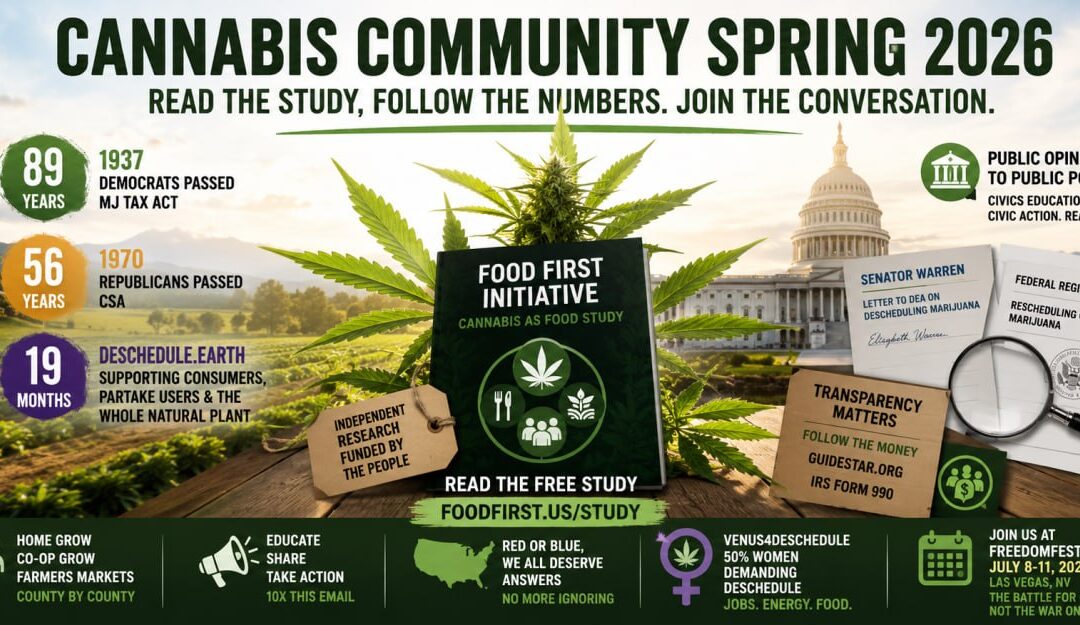
Cannabis Community Spring 2026: Read the Study, Follow the Numbers, and Join the Conversation
The most important request we can make is simple: read the study.
https://www.foodfirst.us/study
Before debating policy, discussing politics, or forming opinions about the future of cannabis reform, take a few minutes to review the research. The study is free, publicly available, and represents an effort to bring objective data into a conversation that has often been shaped by assumptions, politics, competing interests, and decades of conflicting narratives. Whether you support home grow, cooperative cultivation, local agriculture, farmers markets, consumer rights, or broader cannabis reform, the information is worth your time.
At Deschedule.earth, we believe facts matter. We believe data matters. Most importantly, we believe informed citizens can influence public policy when they have access to credible information and are willing to participate in the civic process. The goal is not to tell people what to think. The goal is to provide information that encourages better questions, stronger discussions, and more informed decisions. If you read only one thing from this article, make it the Food First study.
Looking at the Numbers
Historical perspective matters when discussing cannabis policy. It has now been 89 years since the Marijuana Tax Act of 1937 and 56 years since the Controlled Substances Act of 1970. Those laws continue to influence public policy discussions today, even as public opinion, scientific research, and state-level laws continue to evolve.
For the past 19 months, Deschedule.earth has worked to support consumers, advocates, and supporters of the whole natural cannabis plant. During the last 10 months, that work has included volunteer support for FoodFirst.us through fundraising outreach, educational efforts, communications support, and helping connect individuals interested in expanding the national conversation around cannabis.
That work included direct outreach to all 40 NORML chapters across the United States. According to project records, only one chapter, Indiana NORML, provided a financial contribution of more than $100 toward the effort. The purpose of sharing that fact is not to criticize any organization or volunteer group. It is simply part of the story behind how this research was funded and completed.
Additional support included helping raise approximately $3,820 toward a $9,379 research objective, assisting with communications regarding California laboratory data and research release efforts, and continuing to help address an estimated $2,400 remaining balance associated with project financing. Much of this work happened quietly behind the scenes through emails, phone calls, outreach, and networking rather than public announcements.
The larger lesson is straightforward: meaningful projects often move forward because ordinary people decide to participate. Volunteers, small donors, local advocates, and independent researchers frequently make progress possible when larger institutions choose to focus their attention elsewhere.
Why the Food First Initiative Matters
For decades, cannabis discussions have focused primarily on legalization, criminal justice reform, medical access, taxation, and commercial sales. While each of those issues remains important, they represent only part of a much larger conversation.
There are additional questions worth exploring regarding the agricultural, nutritional, and economic value of Cannabis sativa L. What role can cannabis play within food systems? What nutritional benefits may exist? How should policymakers evaluate these questions if independent research is limited? How can informed decisions be made without reliable data?
These questions helped inspire the Food First Initiative and the research available at:
https://www.foodfirst.us/study
The goal is not to replace existing advocacy efforts. The goal is to add information to the discussion and encourage people to evaluate the evidence for themselves. Whether someone agrees or disagrees with the findings, productive debate should begin with actual research rather than assumptions.
The study has also received media attention. High Times covered the project in an article titled, “The Feds Won’t Study Hemp as Food. A Nonprofit Just Did It for $9,379.”
https://hightimes.com/news/the-feds-wont-study-hemp-as-food-a-nonprofit-just-did-it-for-9379/
The article highlights how independent researchers and nonprofit organizations stepped in to conduct work that supporters believed deserved greater attention. Regardless of one’s perspective, it demonstrates that small organizations and volunteers can contribute meaningful research to important public conversations.
Where Is the Support?
One question that emerged during this effort was straightforward: where are the major cannabis advocacy organizations when it comes to supporting food-value research?
Between August 2025 and May 2026, outreach efforts included communication with organizations such as NORML, MPP, DPA, ASA, and LPP. While conversations occurred, significant organizational support for the Food First Initiative was limited. This observation is not intended as criticism. Organizations have different missions, priorities, funding sources, and strategic goals. However, it remains a fair question for supporters to ask whether research into cannabis as food deserves greater attention within the broader reform movement.
If you know leaders, donors, volunteers, or members within these organizations, consider sharing the study with them. Encourage them to review the findings and decide for themselves whether this area of research deserves additional support.
The purpose is not to “put anyone on blast.” The purpose is to observe, report, and encourage discussion based on facts rather than assumptions.
Expanding the Cannabis Conversation
One observation we continue to make is that cannabis discussions often become narrowly focused on a limited set of issues. Commercial operators understandably focus on business opportunities. Advocacy groups frequently concentrate on legislation and regulatory reforms. Consumers often focus on access and affordability. Each of these perspectives is valid, but they do not represent the entire picture.
Cannabis also intersects with agriculture, food systems, energy production, rural economic development, scientific research, consumer choice, and workforce development. These subjects frequently receive less attention despite their potential significance.
The Food First Initiative argues that cannabis should be viewed through a wider lens. Cannabis is not only a criminal justice issue. It is not only a commercial product. It is also connected to food, agriculture, energy, jobs, and economic opportunity. Expanding the conversation creates opportunities to engage new audiences and develop new policy approaches.
Public Opinion to Public Policy
A phrase that continues to guide our efforts is simple: public opinion to public policy.
Policy change does not happen automatically. Research alone does not create change. Social media posts alone do not create change. Lasting reform typically requires informed citizens who understand the issues, communicate effectively, and participate consistently in the democratic process.
For that reason, civic education remains a central part of our mission. Many individuals care deeply about cannabis policy but have never been taught how legislation moves through government, how elected officials make decisions, or how citizens can effectively communicate with policymakers.
Understanding the process matters. Participation matters.
Understanding the Federal Conversation
Anyone interested in cannabis reform should spend time reviewing primary source documents rather than relying solely on media coverage or social media commentary.
One example is Senator Elizabeth Warren’s letter regarding marijuana descheduling:
Readers should also review the Federal Register notice regarding marijuana rescheduling:
Whether you support rescheduling, descheduling, or another approach entirely, these documents provide valuable insight into how federal agencies and policymakers are approaching the issue.
Our position remains straightforward: educate yourself, review the documents, and engage directly with elected officials whenever possible.
Transparency Matters
Another lesson learned throughout this journey is that transparency matters. If you want to understand how advocacy organizations operate, where funding comes from, and how resources are allocated, take time to review publicly available records.
One useful resource is:
GuideStar and IRS Form 990 filings provide citizens with tools to examine nonprofit organizations, understand their finances, and evaluate how resources are being used. Regardless of your political perspective, following the money and understanding organizational structures can help citizens make more informed decisions.
Advocacy, lobbying, nonprofit work, and public policy all involve resources. Transparency helps build trust and accountability.
Building Communities Through Education and Outreach
Education and outreach remain essential parts of this effort. In addition to supporting research initiatives, volunteers continue encouraging practical civic engagement by helping people understand how to communicate with U.S. Senators, House members, state legislators, and local officials.
The goal is not simply to create awareness but to encourage action. Citizens who understand the process are more likely to participate effectively and contribute to meaningful change.
That outreach continues through online communication, community engagement, and in-person events.
One example is FreedomFest, taking place July 8–11, 2026, in Las Vegas, Nevada:
For supporters attending the event, the focus is not on reliving the “War on Drugs.” Instead, the focus is on advancing practical discussions about agriculture, economics, education, civic engagement, and what some have called the ongoing “Battle for Cannabis.”
Looking Ahead
The cannabis community often talks about change, but meaningful progress depends on sustained participation. If you support evidence-based policy discussions, begin by reading the study. If you find value in the information, share it with others. If you disagree with portions of the research, engage respectfully and contribute your perspective. If you possess expertise, experience, or resources that could help advance the conversation, consider becoming involved.
History shows that significant reforms rarely occur because of one organization, one donor, or one activist. Progress is usually the result of thousands of people making small but consistent contributions over long periods of time. The future of cannabis policy will be shaped by those willing to participate, educate themselves, and engage with the process.
Most importantly, start with the study:
https://www.foodfirst.us/study
Read it. Share it. Discuss it. Challenge it. Build upon it.
Every meaningful conversation begins with information, and every lasting policy change begins with citizens who choose to participate. The path from public opinion to public policy starts with informed people willing to take action.